
Jack Bell:
Research that’s made nutrition
care SIMPLER

 Adjunct Professor Jack Bell has dedicated much of his career to addressing malnutrition and undernutrition in older hip fracture patients to improve their outcomes, quality of life and mortality rates, but before that, he was a healthcare user himself.
As a teenager, Jack had been living in the Torres Strait but became extremely unwell and had to relocate to Brisbane for emergency care.
He had his life saved right here under the care of Metro North Health.
“I had leukemia at 13 and 14 and spent a good chunk of those years at the Royal Brisbane Hospital. So, I got a great appreciation of the impact of science, clinical trials and hospitals,” he said.
Growing up, Jack loved many subjects at school, including maths and humanities, but his experience of hospital care and life-saving medicine influenced his desire to work in a field where he could help others. Initially, though, he wasn’t quite sure of his path.
“I nearly became a chef and got offered a chef’s apprenticeship, but I wanted to be a GP, so I ended up studying biomedical science to get into postgrad medicine … Then, I took a year off and went roof tiling. Halfway through that I knew that being a dietitian was where I was headed,” Jack recalled.
His first 15 years as a dietitian were spent at the Royal Brisbane and Women’s Hospital, where he worked across all wards.
Jack begins questioning nutrition care for orthogeriatric patients
In the orthopaedic areas of the hospital, Jack noticed what he describes as a ‘wicked problem’ – a problem that is considered difficult or impossible to solve – that needed deep investigation and critical thinking.
“I saw so many older hip fracture patients have really poor outcomes, because the system didn’t work effectively to prevent that…Their quads wasted in a week or two and they were never going to recover because they were not getting their muscle medicine [protein and energy],” he recalled.
At present, up to 50 per cent of hip fracture patients are already malnourished at their hospital admission, and Jack says that without proper and timely intervention, this increases to around 2 in 3 patients by the time they leave hospital.
The mortality rate of hip fracture patients at 12 months post-discharge is currently just under 25 per cent.
‘Malnutrition a key contributor to poor outcomes’
What Jack had been witnessing in his early career was that malnutrition was a key contributor to poor outcomes – including functional decline, prolonged hospital stays, risk of complications, and mortality – in this frail patient cohort.
He knew there had to be a different way to care for these patients that would offer better outcomes.
“I had some data that showed that the screening tool for malnutrition didn’t work as well as we thought for multi-morbid older people, but I only had it from one hospital site, so I really needed a second site to confirm this,” he explained.
Around the same time, one of the first orthogeriatric units in the country was opened at The Prince Charles Hospital.
“I thought, ‘Here’s an opportunity to not just work with the surgeons, but to work with the whole teams to see if we can prevent this’,” Jack recalled.
“I spent a few months collecting data, and it showed that the screening tool that’s used in many places in the world can miss a lot of hip fracture patients who are living with malnutrition. It was saying they were fine and they weren’t, so they weren’t getting treatment, even in a good team, until it was too late.”
I saw so many older hip fracture patients have really poor outcomes, because the system didn’t work effectively to prevent that…Their quads wasted in a week or two and they were never going to recover because they were not getting their muscle medicine [protein and energy].
– Adjunct Professor Jack Bell
Jack received first grant from the Foundation in 2011
Jack took his clinical observations, findings, and concerns to the hospital’s Director of Dietetics, expressing his passion for improving processes and outcomes.
It was around this time that Jack applied to the Foundation for a Novice Researcher Grant, now known as a New Investigator Grant.
“So, my PhD started because the simple diagnostic accuracy study showed that what we relied on didn’t work. This led to the work around ‘hip fracture is malnutrition risk’ that’s gone global now.”
Jack says his PhD showed that relying on screening tools or dietitians alone for nutrition care for multi-morbid patients in the hip fracture ward doesn’t work as well as a multidisciplinary approach that gets the whole team on board.
“When we started, we knew malnutrition was common, harmful, and costly, but nutrition care was often inconsistent and heavily reliant on individual clinicians. The Foundation gave us the opportunity to move beyond describing the problem and start building solutions,” he said.
“There’s no silver bullet. You can’t just give people supplements, and you can’t just give people a high-protein diet. We want more people spending less time in hospital getting back to normal things… this genuinely is a wicked problem, and wicked problems must have complex solutions.”
From SIMPLE to SIMPLER
It took four to five years of quite complicated investigation before Jack led the development of SIMPLE, the Systemised, Interdisciplinary, Malnutrition Program for imPlementation and Evaluation approach to transform malnutrition care.
The acronym was later tweaked to better match research findings to: Screen for malnutrition, Interdisciplinary assessment, Make the diagnosis and make sure the patient is aware of the diagnosis, Plan with the patient, impLement interventions and Evaluate ongoing care requirements.
This SIMPLE approach continued to evolve, especially as Jack continued to travel and speak to other clinicians around the country and the world.
“What surprised me was how universal the barriers were. Whether you’re in Brisbane, Reykjavik, Oslo, London, Buenos Aires, or Toronto, many hospitals face similar challenges,” he explained.
With this evolution, and with permission and acknowledgement from Queensland Health, the SIMPLE method was adapted into the SIMPLER Nutrition Pathway for Fragility Fractures.
What is The SIMPLER Nutrition Pathway
- Screened at risk: nutrition care is as follows
- Interdisciplinary nutrition assessment and reassessment
- Make the diagnosis, inform the patient/carer and document
- Plan supportive interventions with carer
- L -impLement supportive nutrition interventions
- Evaluate nutrition care provided
- Review, redesign and/or reform practice through audit and quality improvement research and quality
The framework is designed to be adaptable, which allows it to be applied in other countries. Jack describes it as a “choose your own adventure” approach to personalise screening, assessment, and planning for patients.
“The Foundation’s investment helped transform an idea into a model that is now influencing clinical practice, education, policy and quality improvement efforts around the world,” he said.
“The international growth has really come from clinicians recognising their own challenges in the work and seeing that change is possible. Just by making things SIMPLER.”
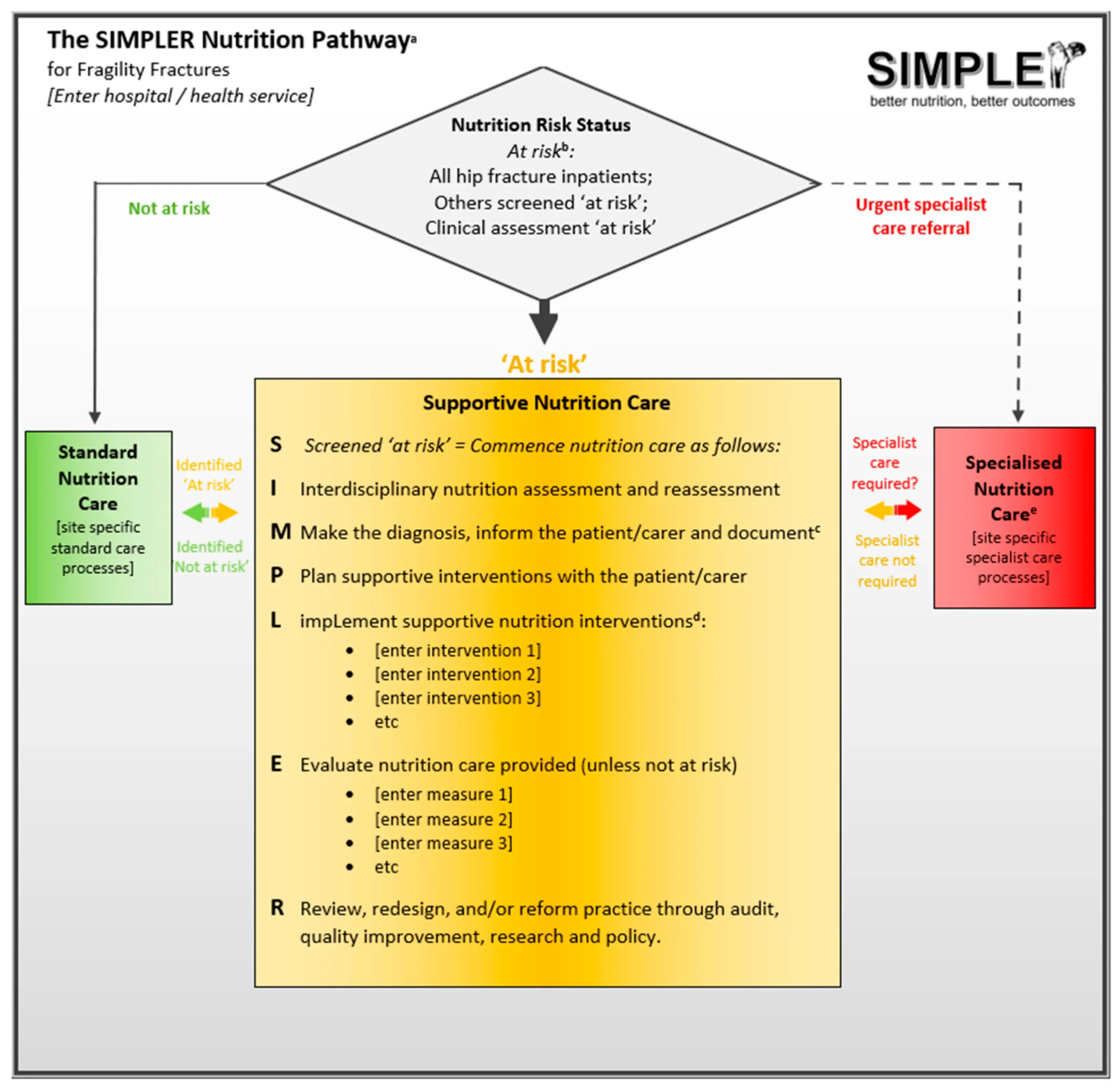
Source: The SIMPLER Nutrition Pathway for Fragility Fractures: A Quality Improvement Initiative. https://pubmed.ncbi.nlm.nih.gov/40573098/
‘Nutrition is now everybody’s business’
Jack says one of the biggest impacts of his research, and the work that has stemmed from it, has been taking nutrition from something that was often seen as the responsibility of dietitians alone and making it everybody’s business.
Now, he says, nutrition is increasingly embedded into routine clinical care rather than being something extra that happens when somebody has time.
“Because of this work, nurses, doctors, assistants, allied health professionals, patients and families are all more actively involved in nutrition care. We’ve seen improvements in nutrition screening, assessment, treatment planning, monitoring and follow-up, but more importantly we’ve seen a shift in culture,” he said.
Global impact of local research
Jack is proud that ideas developed right here at The Prince Charles Hospital are reaching so many people worldwide.
“When I see clinicians in another country adapting and improving a model that started here in Queensland, that’s incredibly rewarding. It tells me the work doesn’t belong to me anymore. It belongs to the people using it to improve care,” he said.
“But most of all, I know that so many people around the world are living healthier, happier lives outside of hospital because we have made nutrition care SIMPLER.”
Jack thanks Foundation supporters
Over the years, the support Jack has received from the Foundation and its donors includes a New Investigator Research Grant 2011, Emerging Researcher 2017, Innovation Grant 2018, Innovation Grant 2021, Innovation Grant 2023, and Endowment Grant 2024.
“I’d say thank you for investing in ideas that don’t yet have proof but have potential. When you’re trying to build something new, early support sends a message that people believe in the idea,” he said.
“When donors support healthcare research and innovation, they’re not just funding projects. They’re creating the conditions for ideas to become real-world improvements. I believe the impact of this investment will continue to grow for many years to come.”
To support more passionate researchers like Jack, click here.
The Foundation’s investment helped transform an idea into a model that is now influencing clinical practice, education, policy and quality improvement efforts around the world.
– Adjunct Professor Jack Bell
Powering today, reinventing tomorrow – your support contributes to life-changing research and patient care initiatives. Donate today and help people live healthier for longer for the next 40 years and beyond.