
Memory Diet Clinic:
Personalised support for outpatients
living with dementia and their carers

 Caring for someone you love who lives with dementia can be overwhelming, and changes in their mood and behaviour can be confusing and difficult to navigate.
When it comes to food, a range of common issues can go hand in hand with these changes and lead to poor nutrition. And sadly, malnutrition in patients with dementia is associated with accelerated cognitive and functional decline.
“Dementia affects so many things: your taste buds, your dexterity – so your ability to hold your cutlery and feed yourself … even just really simple things like you forget to buy food or you forget to eat lunch and then, before you know it, it’s dinner time,” said Hannah Rigby, Dietitian at The Prince Charles Hospital.
“But then there’s the other side of it as well – family members are trying to care for their loved ones the best they can, cooking all of this beautiful food for them and they don’t want to eat it.”
Hannah started her career in general medicine and says she saw many patients who’d been living in the community for years, whose food and nutrient intake was declining, and whose family members had little support.
“I saw things like people not knowing the types of food to eat or not being able to eat enough – things that could be addressed with really simple strategies. And then the family was feeling a bit hopeless as well, like just not knowing who they can talk to or feeling really stressed that their loved one is eating less and fading away, and all they know how to do is cook their favourite food and set up the dinner table and eat with them, and even those things weren’t helping,” said Hannah.
Hospital teams driven to provide personalised support for patients
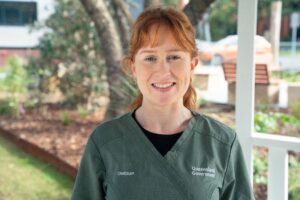 She said that for some of these patients and carers it was their first visit to the hospital, and she was inspired to make a difference by addressing these issues much earlier.
Hannah, along with other clinicians in The Prince Charles Hospital’s Memory Clinic, Geriatrics Clinic, and Dietetics Department, wanted to create an opportunity to empower outpatients with dementia and their carers to make better food choices.
However, it took years of research and questioning to identify barriers to nutritional support and the best ways to help patients and their carers choose appropriate food and nutrition for their circumstances.
Years of Foundation-supported research led to Memory Diet Clinic
 The hospital had existing Memory and Geriatrics outpatient clinics, yet malnutrition screening was not embedded within these. So, one of the first questions the research needed to answer was how many outpatients who visited these clinics with dementia were at risk of malnutrition.
Work as part of the initial new investigator grant awarded by the Foundation in 2019 showed that more than three-quarters (77%) of patients assessed in the clinics were malnourished or at risk of malnutrition.
“There is no suitable screening tool to use in clinics, as every patient is so unique and with the nature of dementia, you can’t ask every patient the standard screening questions because they’re just not suitable. So, we’ve now come to the conclusion that every patient is at risk of malnutrition and therefore they would all benefit from some type of nutritional support,” said Hannah.
I saw things like people not knowing the types of food to eat or not being able to eat enough – things that could be addressed with really simple strategies.
–Hannah Rigby, Dietitian at The Prince Charles Hospital
Gaps and opportunities to improve nutrition care
 What they found was that there were significant barriers to people living with dementia accessing appropriate nutritional care, and that nutrition was often being overlooked for other aspects of care.
As such, there was a need for a coordinated multidisciplinary approach to malnutrition in memory/geriatric clinics to allow for early identification and timely intervention.
“It was clear from the initial new investigator funding that we were firstly, not routinely measuring or providing tailored nutrition care that matters to the patient. Secondly, opportunities to avoid malnutrition (and consequent healthcare usage) were not being realised,” said Principal Research Fellow at The Allied Health Research Collaborative, A/Prof Jack Bell.
Building on these findings, a Foundation-funded Innovation Grant awarded in 2021, supported the next phase of the project. The goal was to design, create, and implement an approach to nutrition care for those living at home with dementia, with dedicated support for their carers and loved ones.
This was developed in consultation with geriatricians, dietitians, nurses, and individuals with lived experience of the disorder, with the group discussing what the barriers are to providing nutritional care to people with dementia and how to improve it.
Memory Diet Clinic led by dietitians with geriatric care experience
The Memory Diet Clinic at The Prince Charles Hospital opened in 2025 and has been in operation for a little over a year now.
Patients with a dementia diagnosis who live in the community and are under the care of a geriatrician at The Prince Charles Hospital are eligible for the service.
“We’re a good in-between service because we communicate with the GP in the community and the geriatricians in the hospital, and we can talk with care providers to set up meals for home. We help to fill the gaps that the geriatricians maybe don’t have time to talk about, as they’re addressing so many things in their appointments such as medications and losing the ability to do everyday tasks like driving,” said Hannah.
This dedicated time with dietitians allows patients and their carers to receive individualised support regarding their personal food concerns.
“Being able to take the time and sit with people and have those important conversations about their loved one’s disease and its progression can ease a lot of their anxieties and their feelings around not doing enough. It’s about helping them, so they have more of an understanding of the condition that they’re dealing with,” said Hannah.
Evidence-based individualised support for patients and carers
This support is evidence-based and may include things like help with eating and drinking strategies, suggestions for food and drink options that suit the patient’s preferences, educational resources related to specific concerns, and setting realistic nutrition goals.
“This could be as simple as making sure the lighting in your dining room is bright and that there’s no clutter in and around where you’re eating, just to minimise distraction and to turn the TV off. Some of these things may seem simple, but people just don’t know that they can make a difference, said Hannah.
Ageing is a research priority area for the Foundation

Supporting older Queenslanders to live well as they age has become an increasing focus for the Foundation. In recent years, donations from the Foundation’s community have helped bring to life projects including Charlie’s Village, a dementia-friendly space designed to provide a more familiar and calming environment for older patients, and Memory Lane, which uses familiar imagery to encourage older patients to stay mobile and increase their step count while in hospital.
The Memory Diet Clinic builds on this important work and reflects the Foundation’s ongoing focus on ageing as a key priority area.
“Through the generosity of our community, the Foundation was able to support this work from its early research stages through to the development of a new service that is now directly supporting people living with dementia and the families who care for them,” said Steve Francia, Chief Executive Officer, The Prince Charles Hospital Foundation.
“That journey from research to real-world patient impact is exactly what we want philanthropy to make possible.”
“It wouldn’t have happened without the Foundation,” said Hannah.
“The grant money gave us time, so it allowed clinicians to have offline time where we could run all the meetings, conduct the interviews and analyse the interview data to allow us to map the barriers and enablers and then come up with what we were going to implement and the nutrition pathway which the includes resources, and the clinic- an entirely new clinic, which I believe is the first dementia-specific clinic for dietitians in Queensland.”
Through the generosity of our community, the Foundation was able to support this work from its early research stages through to the development of a new service that is now directly supporting people living with dementia and the families who care for them.
– Steve Francia, Chief Executive Officer, The Prince Charles Hospital Foundation
Powering today, reinventing tomorrow – your support contributes to life-changing research and patient care initiatives. Donate today and help people live healthier for longer for the next 40 years and beyond.