
Memory Lane
How this hospital hallway assists
with patient recovery

Do you remember Matilda, the beloved winking kangaroo mascot who captivated audiences at the opening and closing ceremonies at the 1982 Commonwealth Games in Brisbane?
Were you at school when free bottles of milk were delivered to and devoured by students?
Or have you heard your grandparents or parents share stories from nights out at the old Cloudland Dance Hall in Bowen Hills?
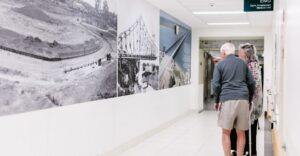 These are questions that patients and visitors who come to The Prince Charles Hospital may be asked as they take a stroll down the Memory Lane corridor, which was funded by the community through the Foundation’s 2022 Giving Day.
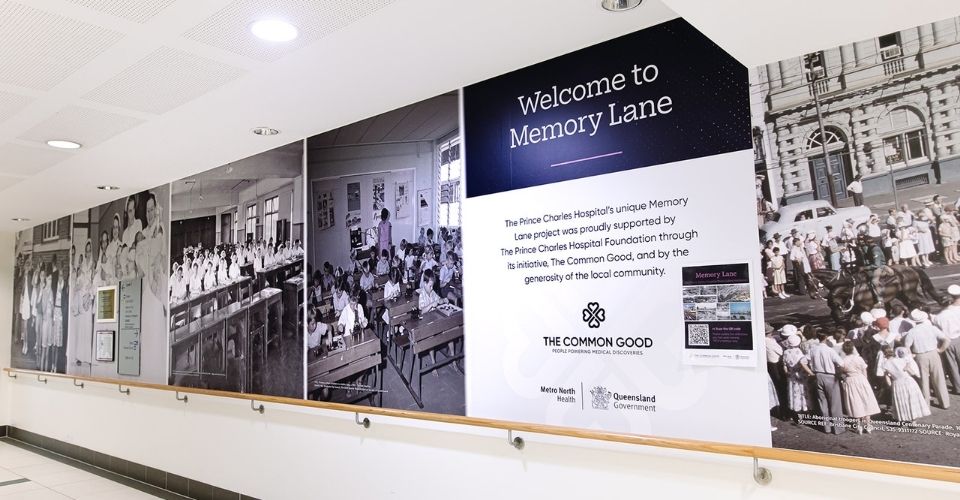
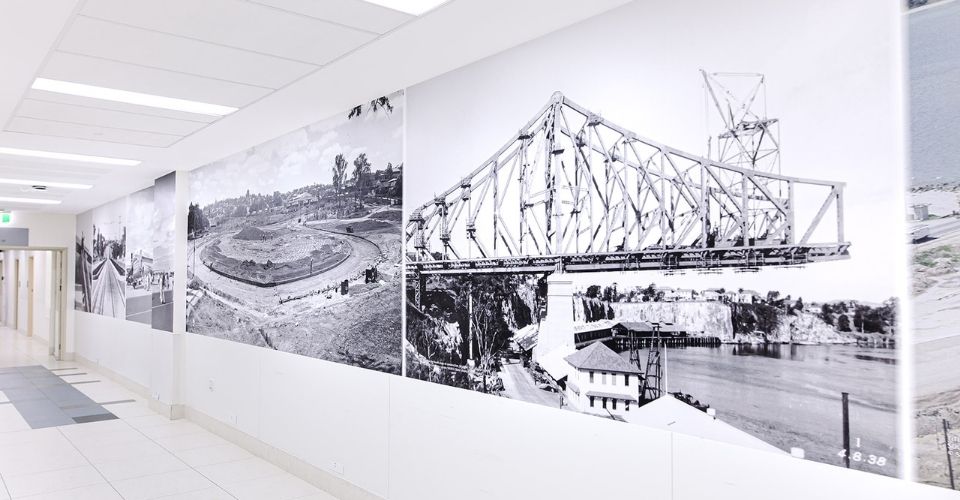
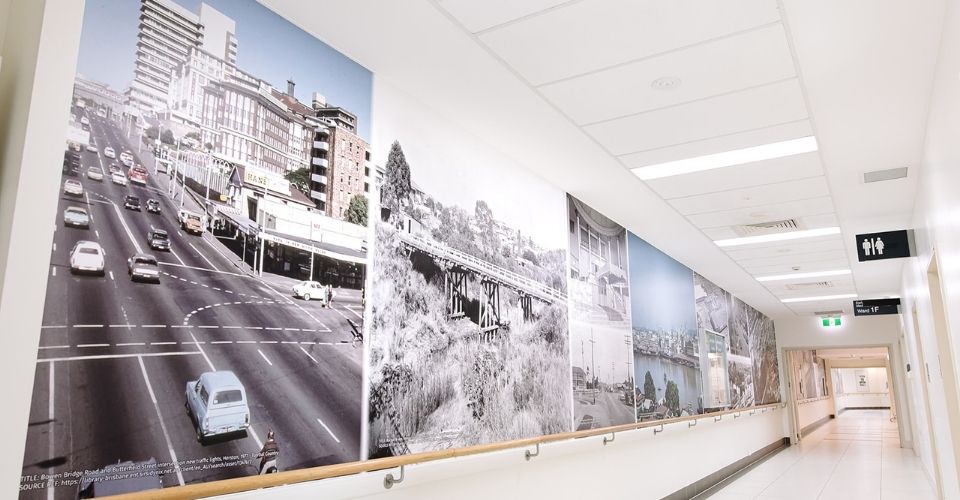
“Stretching roughly 100 metres between our inpatient units, Memory Lane invites you to take a meaningful journey through a curated collection of photographs created in collaboration with our community and staff,” says Kevin Clark, Nursing Director of Internal Medicine Services at The Prince Charles Hospital.
“They’re sequenced in a way that takes a journey through Brisbane and other places in Southeast Queensland that people will remember… Whether it’s travelling on a DC-9 plane, local landmarks under construction like Houghton Highway, Lang Park (now more commonly known as Suncorp Stadium), and the Story Bridge, or being born at a maternity hospital at the Royal Brisbane, there’s a photo there. School milk is often one that triggers a lot of conversations.”
And while this corridor captures memorable moments in history and elicits plenty of conversation, its position – adjacent to the internal medicine and geriatric units – offers far-reaching benefits for some of the hospital’s most frail and vulnerable patients.
“Memory Lane is helping our patients — and equally their families and our hospital staff — build a deeper understanding of each person’s story. It fosters the sense of connection we value, supporting individual care journeys and helping patients feel more at ease as they work towards returning home,” says Kevin.
Memory Lane addressing hospital-associated deconditioning
In particular, patients in Internal Medicine and Geriatric units are at higher risk of hospital-associated deconditioning – a decline in physical and cognitive function due to immobility and bed rest.
“We know that lying in a hospital bed and losing condition (deconditioning) is associated with depression and demoralisation. And that’s completely understandable – any one of us would feel like that,” says Dr Lucy Dakin, the Director of Geriatrics and Subacute Services at The Prince Charles Hospital.
“As we get older, we lose muscle very quickly when we become stationary. So, lying in bed for just a few days, older people can lose a lot of muscle, which is very important for walking and independence.”
Memory Lane supports patients’ functional, emotional, behavioural and physiological well-being, with the project:
- Evoking feelings of nostalgia and enabling reminiscence
- Encouraging mobility by giving people a place to go
- Supporting social connectedness
- Promoting cognitive stimulation
“Memory Lane is a welcoming space beyond the bedside where patients can stroll with staff, family, or friends, exploring photographs and sharing stories along the way. Taking even a short walk or spending time standing offers important physical benefits — helping maintain muscle strength and mobility compared with remaining in bed or seated for long periods. Just as importantly, the conversations and social interaction sparked in this space support cognitive wellbeing and help patients feel more connected during their hospital stay,” says Kevin.
Memory Lane is helping our patients, their families, and our hospital staff build a deeper understanding of each person’s story. It fosters the sense of connection we value, supporting individual care journeys and helping patients feel more at ease as they work towards returning home.
– Kevin Clark, Nursing Director of Internal Medicine Services at TPCH
Memory Lane helps to de-escalate patient behaviours
One recent story about the hallway’s impact involved a patient waiting to be collected by his wife, who was becoming increasingly restless and agitated.
A staff member who was not directly involved in his care observed the situation unfolding and approached slowly and calmly from the side. In a gentle tone, she commented that he looked like he might need a bit of help and asked if he would mind accompanying her for a short walk to look at some photos at Memory Lane.
She discovered that the man had lived in Brisbane for most of his life and asked him questions about the photos to determine whether he’d visited any of the places or remembered any of the events.
The staff member said that he began sharing stories about neighbourhoods, events, and people from his past, and as he did, his body language softened.
“This interaction highlights how thoughtfully designed therapeutic spaces, such as Memory Lane, can play a vital role in de-escalation. By focusing on the person behind the behaviour and drawing on preserved long-term memories, reminiscence therapy can transform risk into rapport and distress into calm, reinforcing the value of person-centred, strengths-based approaches within the clinical setting,” says Dr Eamonn Eeles, Geriatrician at The Prince Charles Hospital.
How the project came to life
A nurse practitioner inspired the upgrade to this corridor by sharing a memory corridor from an overseas hospital.
It took a range of people to bring the project to life, including the compassionate hospital staff from Internal Medicine Services, the team at The Prince Charles Hospital Foundation, and the incredible people who supported the project during Giving Day in 2022.

“It took us 12 to 18 months of planning to achieve this, but it allowed us to co-design this work with patients, family, and our staff, and our community, and really have good engagement with everyone,” says Kevin Clark.
“The Foundation has been really instrumental in helping us right from the initiation of the idea, when our hospital executive approved that we could do this work, to helping us with the planning, connecting us with the right companies. Financial support was really valued and appreciated right through the implementation.”
Supporting meaningful patient care projects
In recent years, the Foundation expanded its focus to include purposeful, patient-centred projects – enhancing infrastructure and reimagining spaces to help support and strengthen care for patients and their families.
It is thanks to agile partnerships, creative thinking, and the unwavering generosity of supporters that these meaningful improvements have been delivered – improvements that hospitals could not achieve on their own.
It’s hoped that these legacy spaces will now benefit patients for decades, inspiring change across hospitals in Queensland and beyond.
If you would like to contribute to projects that make a difference for patients today and tomorrow, we’d love to have a conversation.
Powering today, reinventing tomorrow – your support contributes to life-changing research and patient care initiatives. Donate today and help people live healthier for longer for the next 40 years and beyond.