
Tim McMahon
From congenital heart defect patient at The Prince Charles Hospital to Metro North staff member

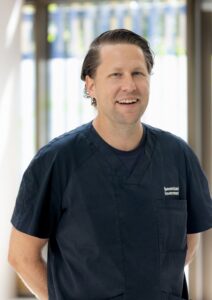 When Tim McMahon was a young child in central Queensland, his mother knew, based on his behaviour, that something wasn’t quite right with his health.
“We used to live in Mackay back in the 90s. I’m one of four kids, and I slept a lot more than my older two siblings, didn’t feed or put on weight at the time. Mum just questioned what was going on, and she took me to a GP. We were out bush somewhere west of Mackay. So, there weren’t that many health services around in Mackay at the time,” Tim said.
The GP confirmed that Tim, who was 13 months at the time, had Aortic Stenosis – a condition impacting the aortic heart valve, which makes it harder for the heart to pump blood to the aorta.
He was referred to a paediatric congenital heart defect team and flew to Brisbane in 1994 to have an aortic valvotomy at The Prince Charles Hospital (TPCH).
After Tim had recovered, they returned to Mackay. But a few years later, in 1998, he was gravely unwell and returned to Brisbane for further treatment.
“I went to the first day of year four, and then the rest of that term, I was in hospital,” Tim recalled.
“I presented with my parents to the emergency department at TPCH, which was a 6-bed unit at the time, and was told to go to the old Royal Children’s Hospital at Herston. A big, burly wardie appeared with a wheelchair, saying he’d spoken to the paediatric unit at TPCH, and they said they’d look after me. By the morning, I had positive blood cultures, which showed I had endocarditis.”
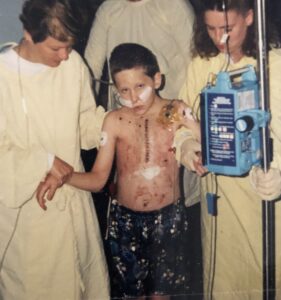 Endocarditis is an infection of the inner lining of the heart’s valves and chambers. It can be fatal. For Tim, it was caused by bacterial tonsillitis and even with a course of antibiotics became blood-borne.
“I’d had a sore throat, a few little other things here and there. The sore throat went away after a bit, but I didn’t get better per se. I was unwell for weeks, with low-grade fevers, lots of lethargy, the fun stuff that will indicate that something probably a little bit more systemic is going wrong. Mum took me to multiple GPs over time. She actually raised concerns that it may have been endocarditis, and none of the GPs at the time did anything regarding any investigations, no blood cultures or anything like that. They told her it couldn’t be endocarditis, as it’s so rare.”
His endocarditis diagnosis was at the very beginning of what turned out to be an 8-week stay at TPCH for Tim, which included open heart surgeries, kidney failure and a serious and highly contagious bacterial infection.
“They did an echo (a cardiac ultrasound), which then found an abscess as well, and I ended up getting a longer catheter put in, which was repeatedly blocked to a point where they inserted subclavian lines, which are used for more long-term venous access,” said Tim.
“And then one afternoon, it was a Thursday afternoon, a cardiothoracic surgeon I hadn’t met appeared, saying that he needed to speak to my parents because the echo I had that day showed some really bad progression of the endocarditis and that I needed emergency surgery, and… Yeah, the next morning I was in for emergency open heart surgery. That was a Friday. I didn’t wake up until the Friday afterwards.”
The then 8-year-old’s aortic valve was replaced, and his mitral valve also had damage that needed to be repaired. He ended up having four sternotomies (chest openings) in a 27-hour period.
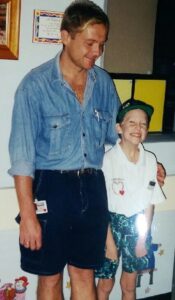 “The third time I got opened up was when I went into septic shock and lost cardiac output, and I had cardiac massage…During that time, they popped a couple of ventricular sutures. But they didn’t know, so they closed me back up and then they found out that I was bleeding significantly. I ended up having, I think, over 120 bags of blood and blood products in that space. And then the next morning, they opened me up and found those sutures that were popped and repaired those,” said Tim.
But the ordeal for 8-year-old Tim was far from over. His kidneys failed, and he was on peritoneal dialysis.
He experienced Red Man syndrome – a reaction which can cause redness and a rash – from all the antibiotics going through too quickly or too concentrated to kill the infection. And he contracted Clostridioides difficile infection, also referred to as C-diff, which is a highly contagious and potentially life-threatening gastrointestinal disease.
Fortunately, he received the treatment he needed to make a full recovery and return home.
“The care that I’ve had at The Prince Charles Hospital has always been superior,” Tim said.
Tim returned to TPCH in 2000 to have his sternum wires removed. His last open-heart surgery was in 2007 at a different hospital, which resulted in a mechanical aortic valve replacement.
“I’d just finished high school at that point. It was a surgery that turned out to be a little more complicated than anticipated. They had to bone crush me because my aortic arch was fused to my sternum. So now I’ve got a synthetic aortic arch as well as a mechanical valve. It was a long surgery; they put me on bypass through a femoral artery. They thought I had a stroke when I woke up because I was angry.”
And then one afternoon, it was a Thursday afternoon, a cardiothoracic surgeon I hadn’t met appeared, saying that he needed to speak to my parents because the echo I had that day showed some really bad progression of the endocarditis and that I needed emergency surgery.
– Tim McMahon
Tim’s personal experience led to a career in health
For Tim, his congenital heart issues and the resulting time in hospital gave him a deep understanding of and empathy for other patients going through challenging health issues.
His desire to help others on their own difficult paths became the launchpad for his own nursing career. His first role was in aged care, and once he had registered, he moved into emergency.
Tim got his first role at Metro North in 2013, working at Redcliffe Hospital’s Rehabilitation unit, then spent 7 years at The Prince Charles Hospital’s Adult Emergency Department then a year at the Royal Brisbane and Women’s Hospital.
“I’ve taken some of my personal experiences, particularly when looking after critically unwell patients, even though they’re not moving and they’re sedated and energised enough, you still talk, I still talk to them. You don’t know what they hear. I can recall conversations…. I can recall a lot of things that occurred during my last open-heart surgery, specifically whilst I was unconscious and out of it. So, it’s important to have that humanity even when caring for someone who’s completely out of it and zonked.”
Tim is now working at Caboolture Hospital’s Emergency Department
Tim is still working at Metro North in the Emergency Department at Caboolture Hospital as the Nurse Educator. In his current role, which he started in 2022, he supports 270 staff in accessing educational resources and guides educational development of resources to align with nursing and wider needs.
“In the four years I’ve been here, I have redesigned the advanced life support program for the directorate, improved access to paediatric-specific training, aligned educational outcomes with the organisational needs,” he explained.
The importance of research to save more lives like Tim’s
 “Personally, research has kept me alive. Without research, children with Congenital Heart Disease traditionally died. We are now living long lives,” Tim said.
Sadly, Tim met many people at a young age who are no longer here.
“I had two friends I made during my 1998 stay who passed away. One was unexpected, when I was in year seven, he died at home… another lived into his mid-20s with a heart-lung transplant but passed away from complications related to medications.
“It’s super important to keep research going as there is still so much we don’t know or are yet to uncover around all of these congenital conditions that can have lasting, better outcomes for the future generations.”
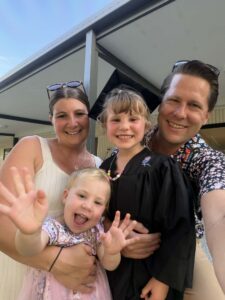
Tim is now a father to two young children, a 5-year-old and a 3-year-old, and he’s grateful that neither of them were born with heart defects.
“There are the genetic factors as well, and there’s always the risk with those… even now when people with a congenital heart defect have children, it increases their risk as well,” he said.
“I’ve got a significantly damaged heart from everything as well. So, thinking ahead, I wonder what does that mean for my future? I don’t know. For the simple fact is that there are probably very few people around in the world that have lived anything like what I’ve experienced at this point in time and have made it into their 30s or even made it into adulthood.”
Tim hopes that by sharing his story, it will create more awareness and inspire more support for research into adult congenital heart defects.
One medical development Tim is particularly amazed by is angiography – a special imaging procedure in which dye is injected into the bloodstream to help detect blood clots or blood vessel abnormalities, such as narrowing or blockages.
“Angiograms have come a long way. I’ve only had a single angiogram, and that was in 2006 when they were doing a check-up. But, you know, now they’re inserting valves through angiograms, and the downtime and recovery time from those successful interactions is amazing,” he said.
“When I had my last open-heart surgery, I was in the prime of trying to learn how to drive. I couldn’t drive for three months after my sternotomy because it took three months for the sternum to heal. So those minimally invasive procedures, such as angiograms, they’re definitely something that is amazing that’s happened.”
Powering today, reinventing tomorrow – your support contributes to life-changing research and patient care initiatives. Donate today and help people live healthier for longer for the next 40 years and beyond.