
Sarah Mackay
Exploring perspectives on malnutrition terminology

 Food and nutrition play a vital role when it comes to health and wellbeing, impacting disease prevention, energy and vitality, physical function and the immune system.
In society, the role of food goes beyond survival and sustenance. Meals are an integral part of milestones and celebrations; they can elicit feelings of comfort, dishes are an expression of culture, and sitting down together to eat can create a sense of belonging.
With all of this in mind, along with the misinformation circulating about nutrition and the rising cost of living, people of all ages can find it difficult to maintain proper nutrition.
New Investigator Grant and PhD Scholarship Recipient, Sarah Mackay, is a Senior Dietitian at The Prince Charles Hospital(TPCH). She sees firsthand the large number of hospital patients who experience malnutrition and it inspired her to dive into research to improve outcomes.
“We know that roughly about 30% of adult inpatients have malnutrition, and about a quarter of long-stay patients in hospital develop malnutrition, or their malnutrition status gets worse during their hospital stay,” says Sarah.
“The implications of that are huge. They end up staying in hospital longer. They’re more likely to get readmitted. Their mortality rate is higher…pressure injuries, falls, and all those other things are much more likely to occur if a person has malnutrition.”
Sarah seeks to understand malnutrition terminology perspectives
 This Senior Dietitian has a love of food and knows it can mean so much more than nutrition, but her time caring for patients and wanting to improve their experiences and outcomes drove her to look for ways to reduce those high malnutrition rates in older hospital patients.
A statewide nutrition audit, in which patients are asked whether they remember being informed about their nutrition diagnosis or nutrition care plan in hospital, showed that a significant proportion of patients don’t really understand their nutritional status.
“Good communication between the health care professional (HCP) and patient improves patient outcomes. While Australian and international malnutrition guidelines highlight the importance of collaboration between the HCP and patient, none specify the terminology to use or factors to consider when informing a patient of malnutrition risk/diagnosis,” Sarah says.
She believes part of this is due to potential communication gaps that could hinder a patient’s decision-making and engagement in their malnutrition prevention and management.
“Conversations with my colleagues made me realise that many of them felt the same way. I saw my research as a way to determine how we should communicate a malnutrition diagnosis in a way that works for patients and caregivers, so they can understand and feel informed about it.”
Malnutrition in older hospital patients
 Approximately two-thirds of older adults living with malnutrition are unaware of their condition. (Lueg et al. 2020, Clinical Interventions in Aging, 15, 2219–2226)
Sarah says malnutrition in the older patients she sees can be multi-factorial. Some things that may contribute to it include inadequate food intake, if the person has lost their appetite or they’re nauseous due to different medications.
“Their medical condition might heighten their nutritional requirements. It might be because their gastrointestinal tract isn’t working properly, so they can’t absorb nutrients from food. But often, the older patients say to us, “Oh, it’s all just a part of getting older,’” she explains.
“I saw research, and translating the findings into practice, as an opportunity to help many patients, rather than just patients one-on-one, as we often do in clinical care. I had also experienced first-hand (and many times over many years) the challenges of communicating a malnutrition diagnosis.”
I’m incredibly grateful for the support from the Foundation and its donors. The PhD scholarship just makes it so much more feasible, a lot more manageable for me, but from a time perspective too, it means that things can happen a little bit faster as well. It also allows me to involve other people in my research.
– Sarah Mackay, Senior Dietitian
 Sarah’s hopes for her research
She hopes her research will lead to a better understanding of health worker, patient and caregiver perspectives on malnutrition terminology/communication, with the aim of:
- Enhancing how health workers locally and internationally discuss malnutrition, empowering older inpatients and caregivers to prevent or improve malnutrition.
- Informing updates to statewide nutrition education materials and best practice guidelines.
- Informing refinements to patient-reported measures in TPCH and statewide malnutrition audits. This will enable accurate assessment of patients’ nutrition care experiences and inform changes to TPCH and statewide malnutrition models of care that support patient experiences and outcomes.
What the Foundation’s support means to Sarah
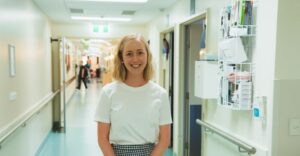 Sarah received a New Investigator Grant from the Foundation in 2023 and a PhD Scholarship in 2025. She says her scholarship has allowed her to have dedicated time away from her full-time clinical dietitian role so she can focus on her PhD research.
“I’m incredibly grateful for the support from the Foundation and its donors. The PhD scholarship just makes it so much more feasible, a lot more manageable for me, but from a time perspective too, it means that things can happen a little bit faster as well. It also allows me to involve other people in my research,” Sarah says.
“I’m really fortunate to have some consumers, previous hospital patients, on my research team. And I feel that without this scholarship, that wouldn’t be possible either. They bring such amazing insights that I otherwise wouldn’t have thought about, making sure the findings truly reflect real-world needs.”
Powering today, reinventing tomorrow – your support contributes to life-changing research and patient care initiatives. Donate today and help people live healthier for longer for the next 40 years and beyond.