Question: Tell us about your research
Answer:
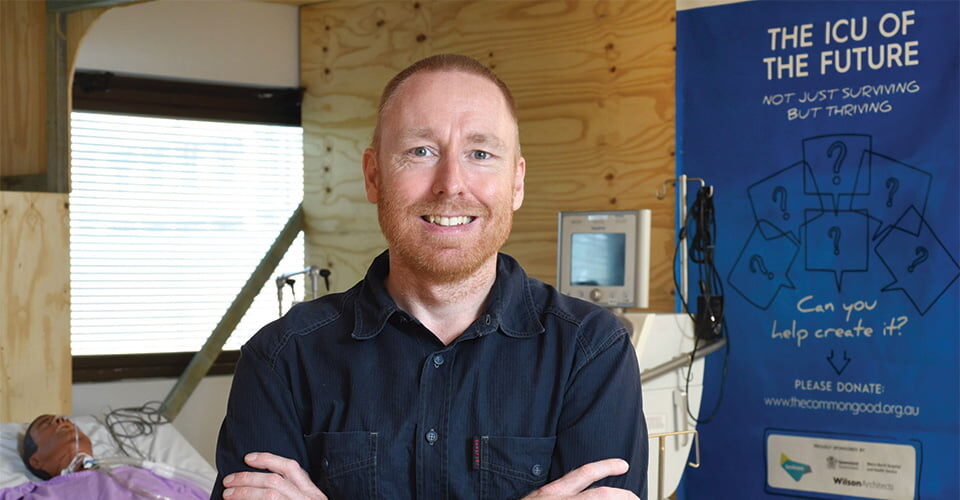
The main project I’m currently leading is the ICU of the Future project, looking at how patients are recovering after an ICU admission. We are investigating how factors like excessive noise and alarms, lack of natural daylight, lack of sleep etc., impact on a patient’s ability to rest and recover. These factors increase the risk of patients experiencing short and long-term problems. To address this, we have worked with patients, family members as well as a large team of collaborators (clinicians, researchers, builders, architects, tech companies etc.) to redesign and build two state-of-the art ICU bedspaces in The Prince Charles Hospital ICU. We expect that these new bedspaces will improve not only the experience of patients admitted to ICU and their family members but also their overall recovery. We want to ensure that people not only survive, but thrive.
The main project I’m currently leading is the ICU of the Future project, looking at how patients are recovering after an ICU admission. We are investigating how factors like excessive noise and alarms, lack of natural daylight, lack of sleep etc., impact on a patient’s ability to rest and recover. These factors increase the risk of patients experiencing short and long-term problems. To address this, we have worked with patients, family members as well as a large team of collaborators (clinicians, researchers, builders, architects, tech companies etc.) to redesign and build two state-of-the art ICU bedspaces in The Prince Charles Hospital ICU. We expect that these new bedspaces will improve not only the experience of patients admitted to ICU and their family members but also their overall recovery. We want to ensure that people not only survive, but thrive.
Question: What does the support of the donors mean to you?
Answer:
The generous support of all the common good donors is invaluable. Both for the researchers but most importantly for our patients and potentially patients everywhere. Research helps us test ways of doing things better, to improve the care provided to future patients. However, research costs money. Sometimes for equipment and testing etc., but also to provide dedicated time to complete the research. Without sufficient and ongoing research funding, projects never get off the ground or are abandoned partway through. Having the support of donors ensures research projects can be completed and the findings implemented, leading to better care. As an example, the ICU of the Future project would never have been implemented without the support of the Common Good and all their volunteers and donors. All researchers are extremely grateful for the generous support provided.
Question: What do you like doing when you are not at work?
Answer:
Having a young family means there’s limited time to do anything other than a combination of full-time work, full-time study (completing a PhD) and the standard family commitments. Previously, I was fortunate enough to travel extensively to see places outside of the normal tourist destinations, meeting people and learning about different cultures.
Question: You are originally from Norway. Is there anything you really miss about your home country?
Answer:
The one thing I used to miss the most when I first came to Australia was the long summer days with daylight until midnight, having a barbeque with friends. Those evenings felt warm at the time, but not sure I would think the same after living here for over two decades… Also, the beautiful nature, and the ability to use it without being at risk of being killed or attacked by deadly and/or venomous animals wherever you go!