“Millions of echocardiograms are performed every year, and almost anyone can undergo one. There are no needles, no pain, no risk, and no radiation, making it a very easily scalable technology. So, being better at answering clinical questions and making diagnoses for more people with a minimalist technology, to me, that is the goal,” Professor Scalia said.
Professor Gregory Scalia AM first stepped into The Prince Charles Hospital as a registrar in the early 90s. Now, as the hospital’s long-standing Director of Echocardiography, he has dedicated most of his career to ensuring that complex cardiac diagnoses are accessible to a much larger portion of the population through echocardiography, with research and practice integral to improving its methods and reach.
“For the first decade or so we tested out half a dozen ideas for improving echocardiography techniques to make diagnoses, because fundamentally our discipline is about democratising cardiac testing. Angiograms are wonderful, but only a small proportion of the population can have them, whereas millions of echo scans are done every year. So, all along the way, we have been trying to make complicated diagnoses with a very simple non-invasive test, inventing several techniques for things like holes in the heart, pulmonary hypertension, and heart failure with preserved function,” Professor Scalia said.
Professor Scalia was awarded the prestigious Member of the Order of Australia in 2024, recognising his decades of outstanding contributions to echocardiography. Reflecting on his journey to this well-deserved honour, he acknowledges how far cardiology has come. In 2025, Prof Scalia was awarded the prestigious Richard Popp Award by the American Society of Echocardiography, for excellence in cardiac education.
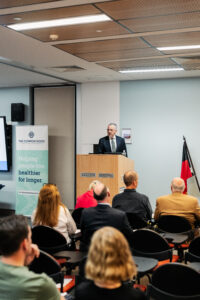
“Back in the day, you did everything—angiograms, pacing, etc. But by the mid-1990s, it was clear cardiology had grown too large for one clinician to do it all. My mentor here at TPCH was Dr Darryl Burstow, who returned from Mayo Clinic in the late 1980’s and taught us it was okay to be a sub-sub specialist. Looking back, it seems preposterous to imagine doing all of cardiology, and we were the trailblazers of learning a single, sub-specialty discipline.”
Professor Scalia, along with Dr Darryl Burstow and Dr Bijoy Khandheria, had been running a small echocardiography meetup in the early 1990s, when the Mayo Clinic approached them about co-branding and becoming the Australian facilitator of a large satellite meeting – Echo Australia.
It was a big feather in the cap for a hospital far from the United States. But having experience running large conferences, and with strong industry support, they launched the first few events in Sydney, attracting 200-300 attendees. The events grew steadily, and by the fifth or sixth year, it was clear Australia needed its own conference. With experience and momentum, they took it over themselves.
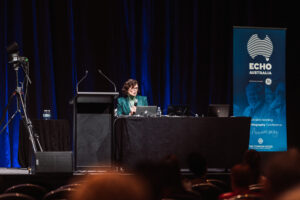
There have now been 22 Echo Australia conferences, where Professor Scalia and colleagues have shared their learnings, equipping thousands with advanced echocardiography techniques. Around 8,600 people have attended this world-renowned event.
“Echocardiography was considered an ancillary method of diagnosis early in my career; however, two major shifts occurred around 2008. Firstly, 3D scanning was developed, allowing us to achieve photo-quality, real-time imaging of a beating heart. Simultaneously, miniaturisation enabled keyhole valve surgery, including mitral, aortic, and TAVI procedures. Both technologies needed each other; you couldn’t do these procedures without photo-quality images. For me, I’d come out of nearly 15 years of open-heart surgery echocardiography, so I was ideally placed to pick up 3D structural imaging. We developed the initial algorithms—how to do this stuff—because none existed. Around 2011, we began sequencing the ultrasound techniques to achieve the desired outcome, and now the approach we developed—widely known as “The Prince Charles Way”—is followed around the world.”
“Passing the knowledge on is the best part. I suspect I’ve given more than 10,000 lectures. We’ve just passed 1,100 whom I’ve taught to do minimally invasive valve procedure echocardiography. I’ve written three international guidelines on these techniques.”
“As Director of Echocardiography at our hospital since 2016, I’m feel like the “proud dad” of our echo program, its graduates, and the discipline of providing excellence in cardiac ultrasound for our patients.”